Andean Languages


Discover the history and evolution of Quechua, one of the most influential Andean languages and a living legacy of ancient civilizations. Explore its origins, regional varieties, cultural significance, and enduring role from the Inca world to modern communities across the Andes. 🏔️📜 Learn how Quechua has preserved ancestral knowledge, shaped Andean identity, and adapted through centuries of social and historical change.

Discover the fascinating history and evolution of Quechua, one of the most important Indigenous language families of the Andes. This subcategory explores how Quechua developed across the highlands of Peru, Bolivia, Ecuador, Colombia, Chile, and Argentina, while examining its deep connections with Andean civilizations, Inca administration, oral tradition, identity, and cultural heritage. Readers will find accessible, well-researched information about Quechua origins, dialects, historical change, language contact, and modern revitalization within the broader story of Andean history.
Learn about the proposed origins of the Quechua language family and the historical debates surrounding its earliest geographic centers. This section examines linguistic evidence, archaeological context, migration theories, and the role of long-distance exchange networks in the development of Quechua across the Andes. Because written records are limited before the colonial period, researchers combine comparative linguistics, oral histories, colonial documents, and archaeological findings to reconstruct the language’s past.
Readers can also explore how early Quechua varieties evolved alongside societies such as the Moche, Nazca, Tiahuanaco, Wari, and other Andean cultures. These discussions clarify that Quechua history is broader than the Inca Empire and reveal how language, trade, religion, agriculture, and political organization shaped communication in the Andes.
Understand the important relationship between Quechua and the expansion of the Inca state, or Tawantinsuyu. As Inca influence spread across the Andes, different forms of Quechua were used in administration, diplomacy, religious practices, military organization, and communication between diverse communities. This section explains how language functioned as a practical tool of governance without assuming that every population in the empire originally spoke Quechua.
Explore the role of Quechua in imperial institutions, oral traditions, place names, political titles, and the transmission of historical knowledge. Readers will gain insight into how Quechua supported Andean administration and cultural exchange, while also learning about the multilingual reality of the Inca world, which included languages such as Aymara, Puquina, and many regional languages.
Quechua is not a single uniform form of speech but a diverse language family with numerous regional varieties. This section introduces major Quechua branches and dialect areas, including Southern Quechua, Central Quechua, Northern Quechua, and varieties spoken in Peru, Bolivia, Ecuador, Colombia, Argentina, and Chile. Readers will learn how pronunciation, vocabulary, grammar, and everyday expressions can differ from one region to another.
The content also explains why dialect diversity matters for Quechua linguistics, Indigenous identity, education, translation, and language preservation. Rather than treating variation as a problem, this approach presents regional Quechua traditions as an important part of the language’s richness and historical development.
Examine how the Spanish conquest transformed the history of Quechua. Colonial administrators, missionaries, and chroniclers documented several Quechua varieties, creating grammars, vocabularies, religious texts, and bilingual materials. These records provide valuable evidence for historical linguistics, although they must be interpreted carefully because they often reflect European writing systems, colonial objectives, and outside descriptions of Indigenous societies.
This section also explores how Quechua was used in evangelization, legal petitions, local administration, and community life. Readers will discover how colonial policies alternately promoted and restricted Indigenous languages, contributing to long-term changes in Quechua vocabulary, writing, social status, and language contact with Spanish.
Learn how Quechua has been represented in writing from the colonial era to the present. Since Quechua was traditionally transmitted primarily through speech, memory, performance, and community practice, early written documentation relied on the Latin alphabet adapted by missionaries and scholars. This section considers spelling conventions, regional orthographies, historical manuscripts, dictionaries, and contemporary writing systems.
Readers will also explore the importance of documentation for education, publishing, digital communication, and cultural preservation. Topics include Quechua alphabet standards, bilingual texts, oral history transcription, digital resources, and Indigenous authorship, providing a clearer understanding of how written Quechua continues to evolve.
Quechua has changed through centuries of interaction with other Andean and European languages. This section examines contact with Aymara, Spanish, and local Indigenous languages, focusing on borrowed words, shifts in pronunciation, grammar, place names, and patterns of bilingual communication. These changes demonstrate that Quechua is a living language shaped by historical encounters and contemporary realities.
The discussion also considers how migration, urbanization, schooling, media, tourism, and technology influence modern Quechua. By studying these processes, readers can better understand language evolution in the Andes and the ways Quechua speakers adapt their language while maintaining cultural continuity.
Discover the current status of Quechua and the efforts to strengthen its use in homes, schools, universities, public institutions, media, and online communities. Although Quechua remains one of the most widely spoken Indigenous language families in the Americas, many varieties face pressure from language shift, discrimination, limited educational resources, and unequal access to public services.
This section highlights community-led revitalization, bilingual and intercultural education, Quechua music, literature, film, social media, and language-learning initiatives. It emphasizes that Quechua revitalization is connected to Indigenous rights, cultural pride, historical recognition, and the preservation of Andean knowledge.
Quechua is a family of related Indigenous languages spoken mainly in the Andes. It includes numerous regional varieties found across Peru, Bolivia, Ecuador, Colombia, Chile, and Argentina. Quechua is associated with Andean history, but it predates the Inca Empire and continues to be spoken by millions of people today.
No. The Incas did not create Quechua. The language family existed before the rise of the Inca state, although the empire helped spread certain Quechua varieties through administration, political expansion, trade, and population movement. The Inca world was multilingual, and Quechua was one of several important languages.
The exact number depends on how linguists define a language and a dialect. Quechua includes many regional varieties with differences in vocabulary, grammar, and pronunciation. Linguists commonly group these varieties into broad branches such as Northern, Central, and Southern Quechua, while recognizing substantial diversity within each group.
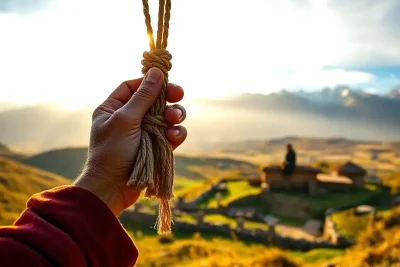
Quechua was primarily preserved through oral traditions, including storytelling, songs, ritual speech, historical recitation, and community teaching. The Inca used systems such as khipu for recording information, although the relationship between khipu and spoken Quechua remains an important area of research. More extensive alphabetic writing of Quechua began during the colonial period.
Yes. Quechua remains a living language family spoken by millions of people, particularly in Peru, Bolivia, and Ecuador, as well as in other Andean regions and migrant communities. Its future depends on language transmission, respectful education, public recognition, digital resources, and community-led efforts to protect and expand its use.